
When planning an industrial shed, warehouse, factory, or commercial structure, one important decision can impact your cost, timeline, and future expansion:
👉 Should you choose Pre Engineered Buildings (PEB Buildings) or a normal RCC building?
With engineered buildings becoming more popular across India, it’s important to understand how they compare with conventional construction. Let’s look at this in a practical, real-world way—not theory.
What Are Pre Engineered Buildings (PEB Buildings)?
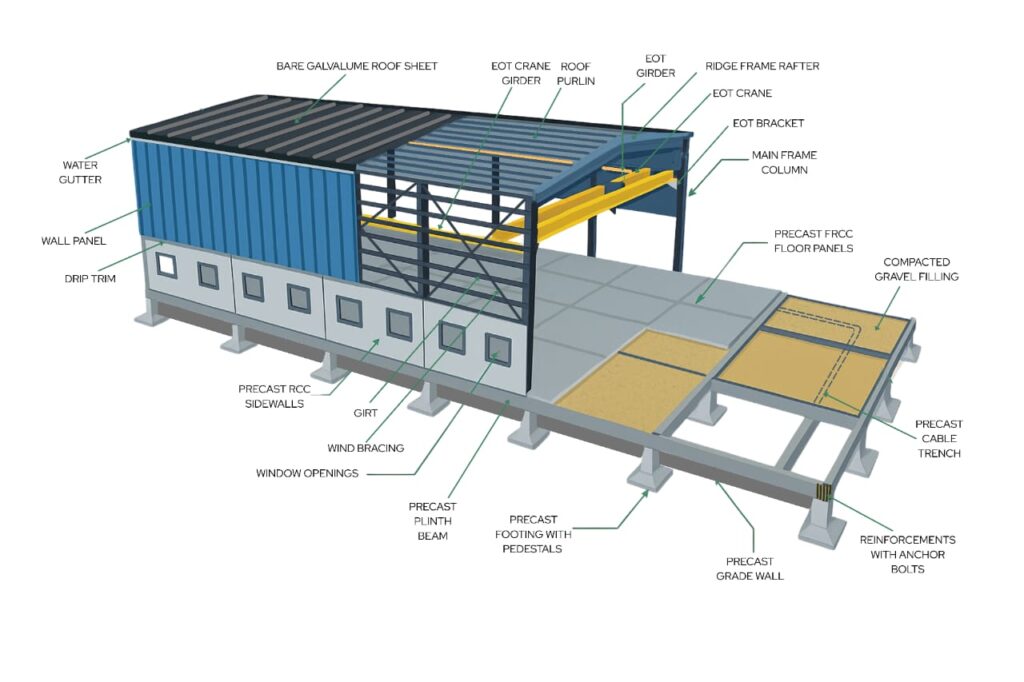
Pre engineered buildings are steel structures that are designed, engineered, and manufactured in a controlled factory environment, then transported to site and assembled.
Every component is pre-designed using engineering software, ensuring accuracy, strength, and speed. That’s why they are also called engineered buildings.
PEB buildings are widely used for:
- Warehouses
- Factories
- Industrial sheds
- Logistics hubs
- Commercial buildings with large spans
What Is a Normal (Conventional) Building?
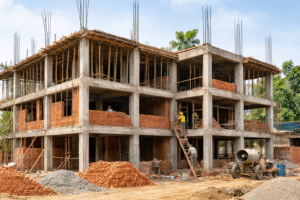

A normal building usually refers to RCC construction, built completely at site using cement, bricks, sand, steel, and manual labour.
This method has been in use for decades and works well for:
Residential buildings
Apartments
Small commercial structures
Multi-storey buildings
Key Differences Between Pre Engineered Buildings and Normal Buildings
1. Construction Speed
Pre Engineered Buildings (PEB Buildings):
Since most fabrication happens in a factory, site work is limited to foundation and erection.
Projects are completed 30–50% faster than conventional buildings.
Normal Buildings:
Construction depends on multiple site activities like curing, plastering, and finishing, which increases timelines.
Better option: Pre engineered buildings
2. Cost Efficiency
PEB Buildings:
Optimized steel design
Minimal material wastage
Lower labour dependency
Faster completion reduces overhead costs
For large-span engineered buildings, PEB construction is generally 10–20% more economical.
Normal Buildings:
Higher material wastage
Longer construction duration
Increased labour costs
Better option: Pre engineered buildings
3. Structural Strength & Engineering
Engineered Buildings (PEB):
PEB buildings are designed to handle:
Heavy loads
High wind speeds
Seismic activity
Since every member is engineered, performance is predictable and reliable.
Normal Buildings:
Strength depends heavily on site workmanship and quality control.
Better option: Both, if executed properly
4. Flexibility & Future Expansion
PEB buildings are highly flexible. You can easily:
Extend the building length
Add bays
Modify layouts
Normal Buildings:
Expansion is difficult, expensive, and sometimes structurally restricted.
Better option: Pre engineered buildings
5. Maintenance & Longevity
PEB Buildings:
Easy inspection
Periodic painting or coating
Lower long-term maintenance
Normal Buildings:
Cracks, seepage, plaster repairs over time
Higher maintenance costs in many cases
Better option: Pre engineered buildings
6. Appearance & Design
Engineered Buildings:
Modern PEB buildings look clean, professional, and industrial. Suitable for factories and commercial use.
Normal Buildings:
Better for detailed architectural designs and residential aesthetics.
Better option: Depends on project purpose
Quick Comparison: PEB Buildings vs Normal Buildings
| Factor | Pre Engineered Buildings | Normal Buildings |
|---|---|---|
| Speed | Very Fast | Slow |
| Cost | Economical | Higher |
| Wastage | Minimal | More |
| Expansion | Easy | Difficult |
| Maintenance | Low | Moderate to High |
| Best Use | Industrial & Commercial | Residential |
When Should You Choose Pre Engineered Buildings?
Choose PEB buildings or engineered buildings if you need:
Faster project delivery
Cost control
Large clear spans
Future expansion flexibility
Industrial or warehouse use
Choose normal buildings if:
The project is residential
Multi-storey construction is required
Architectural detailing is a priority
Final Words
Today’s construction decisions are no longer just about building structures—they’re about efficiency, performance, and long-term value.
With the rise of pre engineered buildings and PEB buildings, industries now have a smarter, faster, and more reliable construction solution.
Choosing the right system at the planning stage can save time, money, and future complications.